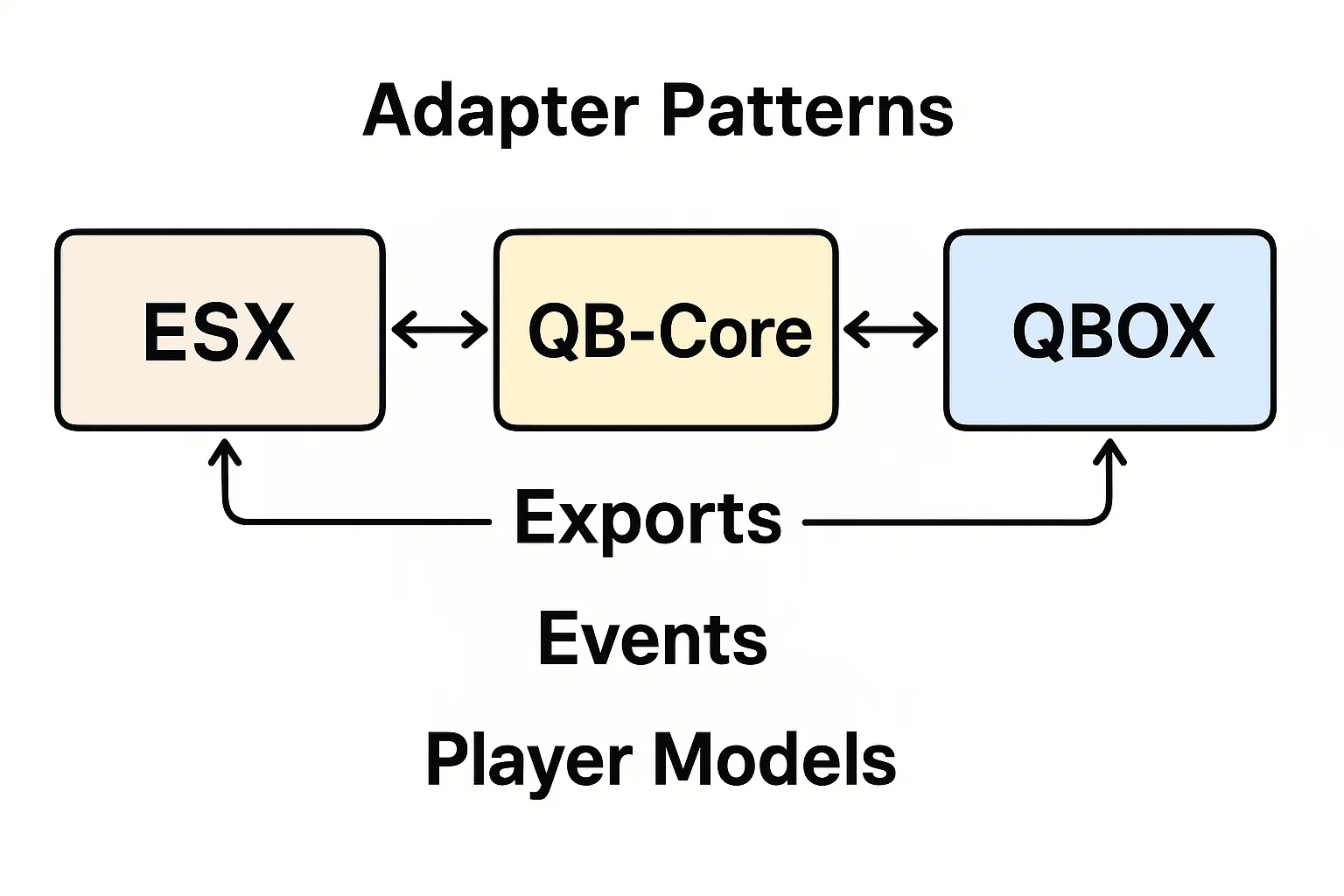
Adapter Patterns: ESX, QBCore & QBOX (Exports, Events & APIs)
This is a FiveM Framework Adapter – for scripters. Ship one resource that runs on ESX, QBCore, and QBOX by isolating framework‑specific calls behind a thin adapter. Drop the shared/fw.lua and per‑framework adapters below into any resource, call the stable interface contract (FW.Player, FW.Job, FW.Money, FW.Inv, FW.Events), and keep business logic framework‑agnostic. A small test matrix with stubs catches mismatches before you deploy.
Why an Adapter?
Framework differences cluster around the same seams:
- Core access (ESX
getSharedObject, QBCoreGetCoreObject, QBOX exports only) - Player model (xPlayer vs Player/PlayerData)
- Identifiers (license/steam vs citizenid)
- Money & inventory APIs
- Event names at load/login/job‑update time
A unified interface keeps these seams out of your game logic. You swap the adapter, not the codebase.
BTW: You can use our written adapter here, for free:
How to Use (Drop‑in)
Tree (suggested):
my-resource/
├─ fxmanifest.lua
├─ shared/
│  ├─ adapters/
│  │  ├─ esx.lua
│  │  ├─ qb.lua
│  │  └─ qbox.lua
│  └─ fw.lua
├─ server/
│  └─ main.lua
└─ client/
   └─ main.lua
fxmanifest.lua (load adapters first, then fw.lua so detection can bind):
fx_version 'cerulean'
game 'gta5'
lua54 'yes'

shared_scripts {
  'shared/adapters/*.lua',
  'shared/fw.lua'
}

client_scripts {
  'client/*.lua'
}

server_scripts {
  '@oxmysql/lib/MySQL.lua', -- optional: if you use SQL
  'server/*.lua'
}
In your code (server or client):
-- use the stable interface everywhere
local src = source
local p = FW.Player.getBySrc(src)
local job = FW.Job.getName(p)
FW.Money.add(p, 'cash', 250, 'delivery-bonus')
FW.Inv.addItem(p, 'water', 1)
FW.Events.notify(src, 'Job bonus paid.', 'success')
The only symbol you depend on is
FW. Everything else is internal to the adapters.
Interface Contract (stable surface)
Design goal: Small, explicit, documented. These are the functions you can rely on across frameworks.
FW.meta
name() -> 'esx'|'qbcore'|'qbox'has(resourceName: string) -> boolean(resource started?)
FW.Player
getBySrc(src: number) -> any(framework player handle)getStateId(p) -> string(ESX: identifier; QB/QBOX: citizenid)getServerId(p) -> number(numeric id)getName(p) -> string
FW.Job
getName(p) -> stringgetGrade(p) -> number|stringonChange(handler(src, oldJob, newJob))(fires when job changes, if detectable)
FW.Money
get(p, account: 'cash'|'bank'|'black_money'?) -> numberadd(p, account, amount: number, reason?: string)remove(p, account, amount: number, reason?: string)
FW.Inv (best‑effort; see Notes)
addItem(p, name: string, count: number, metadata?: table) -> booleanremoveItem(p, name: string, count: number, metadata?: table) -> boolean
Inventory note: servers vary (qb-inventory, ox_inventory, qs‑inventory, etc.). The default implementation uses framework inventory when available and falls back to
ox_inventoryif detected.
FW.Events
notify(target: number, msg: string, type?: 'info'|'success'|'error')onPlayerLoaded(handler(src))(best‑effort, with fallback viaplayerJoining)
Drop‑in Adapters (copy/paste)
These are pragmatic defaults. If your fork differs (especially for QBOX), adjust the few marked comments.
shared/fw.lua
-- framework bridge bootstrap
FW = FW or {}

local function started(name)
  local st = GetResourceState(name)
  return st == 'started' or st == 'starting'
end

local which
if started('qbx_core') then which = 'qbox'
elseif started('qb-core') then which = 'qbcore'
elseif started('es_extended') then which = 'esx' end

if which == 'qbcore' then
  FW = Adapters.qb()
elseif which == 'qbox' then
  FW = Adapters.qbox()
elseif which == 'esx' then
  FW = Adapters.esx()
else
  error('[FW] No supported framework found (es_extended / qb-core / qbx_core).')
end

-- tiny helpers common to all adapters
function FW.meta.has(res)
  return started(res)
end
shared/adapters/esx.lua
Adapters = Adapters or {}

Adapters.esx = function()
  local ESX = exports['es_extended']:getSharedObject()

  local M = {
    meta = { name = function() return 'esx' end },
    Player = {}, Job = {}, Money = {}, Inv = {}, Events = {}
  }

  -- Player
  function M.Player.getBySrc(src) return ESX.GetPlayerFromId(src) end
  function M.Player.getStateId(p) return p.identifier end
  function M.Player.getServerId(p) return p.source end
  function M.Player.getName(p) return p.getName and p.getName() or GetPlayerName(p.source) end

  -- Job
  function M.Job.getName(p) return (p.getJob and p.getJob().name) or (p.job and p.job.name) end
  function M.Job.getGrade(p)
    local j = p.getJob and p.getJob() or p.job
    return j and (j.grade or (j.grade and j.grade.grade))
  end
  function M.Job.onChange(handler)
    -- ESX fires when job changes (commonly 'esx:setJob')
    RegisterNetEvent('esx:setJob', function(job)
      local src = source
      handler(src, nil, job and job.name)
    end)
  end

  -- Money
  local function norm(account) return account == 'cash' and 'money' or account end
  function M.Money.get(p, account)
    account = norm(account)
    if account == 'money' then return p.getMoney() end
    local acc = p.getAccount and p.getAccount(account)
    return acc and acc.money or 0
  end
  function M.Money.add(p, account, amount)
    account = norm(account)
    if account == 'money' then p.addMoney(amount) else p.addAccountMoney(account, amount) end
  end
  function M.Money.remove(p, account, amount)
    account = norm(account)
    if account == 'money' then p.removeMoney(amount) else p.removeAccountMoney(account, amount) end
  end

  -- Inventory (ESX native, with ox fallback)
  local hasOX = GetResourceState('ox_inventory') == 'started'
  if hasOX then
    function M.Inv.addItem(p, name, count, meta) return exports.ox_inventory:AddItem(p.source, name, count, meta) end
    function M.Inv.removeItem(p, name, count, meta) return exports.ox_inventory:RemoveItem(p.source, name, count, meta) end
  else
    function M.Inv.addItem(p, name, count) p.addInventoryItem(name, count); return true end
    function M.Inv.removeItem(p, name, count) p.removeInventoryItem(name, count); return true end
  end

  -- Events
  function M.Events.notify(target, msg, kind)
    kind = kind or 'info'
    -- Implement your UI notify event here. Example placeholder:
    TriggerClientEvent('fw:notify', target, msg, kind)
  end
  function M.Events.onPlayerLoaded(handler)
    RegisterNetEvent('esx:playerLoaded', function(_)
      handler(source)
    end)
  end

  return M
end
shared/adapters/qb.lua (QBCore)
Adapters = Adapters or {}

Adapters.qb = function()
  local QBCore = exports['qb-core']:GetCoreObject()

  local M = {
    meta = { name = function() return 'qbcore' end },
    Player = {}, Job = {}, Money = {}, Inv = {}, Events = {}
  }

  -- Player
  function M.Player.getBySrc(src) return QBCore.Functions.GetPlayer(src) end
  function M.Player.getStateId(p) return p.PlayerData.citizenid end
  function M.Player.getServerId(p) return p.PlayerData.source end
  function M.Player.getName(p)
    local pd = p.PlayerData
    return (pd.charinfo and (pd.charinfo.firstname .. ' ' .. pd.charinfo.lastname)) or GetPlayerName(pd.source)
  end

  -- Job
  function M.Job.getName(p) return p.PlayerData.job.name end
  function M.Job.getGrade(p)
    local g = p.PlayerData.job.grade
    return type(g) == 'table' and (g.level or g.grade) or g
  end
  function M.Job.onChange(handler)
    -- QBCore client event relays job update; mirror serverside via simple relay if needed.
    RegisterNetEvent('QBCore:Server:OnJobUpdate', function(job)
      handler(source, nil, job and job.name)
    end)
  end

  -- Money
  function M.Money.get(p, account) return p.PlayerData.money[account] or 0 end
  function M.Money.add(p, account, amount, reason) p.Functions.AddMoney(account, amount, reason or 'fw') end
  function M.Money.remove(p, account, amount, reason) p.Functions.RemoveMoney(account, amount, reason or 'fw') end

  -- Inventory (qb-inventory or ox)
  local hasOX = GetResourceState('ox_inventory') == 'started'
  if hasOX then
    function M.Inv.addItem(p, name, count, meta) return exports.ox_inventory:AddItem(p.PlayerData.source, name, count, meta) end
    function M.Inv.removeItem(p, name, count, meta) return exports.ox_inventory:RemoveItem(p.PlayerData.source, name, count, meta) end
  else
    function M.Inv.addItem(p, name, count, meta) return p.Functions.AddItem(name, count, false, meta) end
    function M.Inv.removeItem(p, name, count) return p.Functions.RemoveItem(name, count) end
  end

  -- Events
  function M.Events.notify(target, msg, kind)
    TriggerClientEvent('fw:notify', target, msg, kind or 'info')
  end
  function M.Events.onPlayerLoaded(handler)
    RegisterNetEvent('QBCore:Server:PlayerLoaded', function()
      handler(source)
    end)
  end

  return M
end
shared/adapters/qbox.lua (QBOX / qbx_core)
Adapters = Adapters or {}

Adapters.qbox = function()
  -- QBOX typically exposes functions via exports only.
  -- If your fork also ships a GetCoreObject, swap accordingly.
  local QBX = exports['qbx_core']

  local M = {
    meta = { name = function() return 'qbox' end },
    Player = {}, Job = {}, Money = {}, Inv = {}, Events = {}
  }

  -- Player (QBOX uses Player with PlayerData similar to QBCore)
  function M.Player.getBySrc(src) return QBX:GetPlayer(src) end -- adjust if your API differs
  function M.Player.getStateId(p) return p.PlayerData.citizenid end
  function M.Player.getServerId(p) return p.PlayerData.source end
  function M.Player.getName(p)
    local pd = p.PlayerData
    return (pd.charinfo and (pd.charinfo.firstname .. ' ' .. pd.charinfo.lastname)) or GetPlayerName(pd.source)
  end

  -- Job
  function M.Job.getName(p) return p.PlayerData.job.name end
  function M.Job.getGrade(p)
    local g = p.PlayerData.job.grade
    return type(g) == 'table' and (g.level or g.grade) or g
  end
  function M.Job.onChange(handler)
    -- Some QBOX builds forward QBCore job events; if not, wire your own when setting jobs.
    RegisterNetEvent('QBCore:Server:OnJobUpdate', function(job)
      handler(source, nil, job and job.name)
    end)
  end

  -- Money
  function M.Money.get(p, account) return p.PlayerData.money[account] or 0 end
  function M.Money.add(p, account, amount, reason)
    if p.Functions and p.Functions.AddMoney then p.Functions.AddMoney(account, amount, reason or 'fw')
    else QBX:AddMoney(p.PlayerData.source, account, amount, reason or 'fw') end
  end
  function M.Money.remove(p, account, amount, reason)
    if p.Functions and p.Functions.RemoveMoney then p.Functions.RemoveMoney(account, amount, reason or 'fw')
    else QBX:RemoveMoney(p.PlayerData.source, account, amount, reason or 'fw') end
  end

  -- Inventory (ox preferred on many QBOX servers)
  local hasOX = GetResourceState('ox_inventory') == 'started'
  if hasOX then
    function M.Inv.addItem(p, name, count, meta) return exports.ox_inventory:AddItem(p.PlayerData.source, name, count, meta) end
    function M.Inv.removeItem(p, name, count, meta) return exports.ox_inventory:RemoveItem(p.PlayerData.source, name, count, meta) end
  else
    -- fall back to qb-style if present
    if p and p.Functions and p.Functions.AddItem then
      function M.Inv.addItem(p, name, count, meta) return p.Functions.AddItem(name, count, false, meta) end
      function M.Inv.removeItem(p, name, count) return p.Functions.RemoveItem(name, count) end
    else
      function M.Inv.addItem() return false end
      function M.Inv.removeItem() return false end
    end
  end

  -- Events
  function M.Events.notify(target, msg, kind)
    TriggerClientEvent('fw:notify', target, msg, kind or 'info')
  end
  function M.Events.onPlayerLoaded(handler)
    -- Some QBOX builds reuse QBCore load events; if yours differs, relay from your login logic.
    RegisterNetEvent('QBCore:Server:PlayerLoaded', function()
      handler(source)
    end)
  end

  return M
end
Usage Examples
1) Paying a job bonus
RegisterNetEvent('myres:payBonus', function()
  local src = source
  local p = FW.Player.getBySrc(src)
  if not p then return end

  if FW.Job.getName(p) == 'delivery' then
    FW.Money.add(p, 'cash', 250, 'delivery-bonus')
    FW.Events.notify(src, 'Bonus paid (+$250).', 'success')
  else
    FW.Events.notify(src, 'You are not on duty as Delivery.', 'error')
  end
end)
2) Inventory grant with ox fallback already handled
local function giveStarter(src)
  local p = FW.Player.getBySrc(src)
  if p then FW.Inv.addItem(p, 'water', 2) end
end
FW.Events.onPlayerLoaded(giveStarter)
Anti‑Pattern Catalog (and Fixes)
| Anti‑pattern | Why it bites | Fix with adapter |
|---|---|---|
Hard‑coding core object (ESX = exports['es_extended']:getSharedObject() scattered everywhere) | Locks you into ESX, tedious to migrate | Only call FW.*. Core resolution lives in adapter. |
Storing framework player handle long‑term (e.g., keep xPlayer in a table forever) | Handles can go stale; references differ per framework | Re‑fetch via FW.Player.getBySrc(src) when you act, or cache by getStateId key and re‑resolve. |
Assuming identifiers are the same (ESX identifier vs QB/QBOX citizenid) | Breaks DB relations/migrations | Use FW.Player.getStateId(p) and a crosswalk table during migrations. |
Direct event names in business logic (esx:playerLoaded, QBCore:Server:PlayerLoaded) | Fragile across forks | Subscribe via FW.Events.onPlayerLoaded. |
| Mixed inventory assumptions | Servers swap inventories often | Use FW.Inv.* which detects ox_inventory first, then framework. |
| SQL schemas frozen to one framework | accounts, identifier, etc. diverge | Use neutral columns (state_id, money_cash, money_bank) and migration helpers below. |
SQL & Identifier Migration Notes (Quick Reference)
- Primary person key:
- ESX →
identifier(license/steam) - QB/QBOX →
citizenid - Neutral key in your tables:
state_id(string). StoreFW.Player.getStateId(p). - Money:
- ESX:
money(cash),accounts.bank,accounts.black_money - QB/QBOX:
PlayerData.money.cash|bank - Minimal crosswalk (one‑time backfill):
- ESX:
- ESX →
-- Example: populate your neutral key from ESX users
UPDATE my_table t
JOIN users u ON u.identifier = t.identifier
SET t.state_id = u.identifier
WHERE t.state_id IS NULL;

-- Example: migrate to QB/QBOX where you have a mapping table esx_identifier→citizenid
UPDATE my_table t
JOIN id_map m ON m.esx_identifier = t.state_id
SET t.state_id = m.citizenid
WHERE m.citizenid IS NOT NULL;
Keep the crosswalk (
id_map) only during the transition; future writes should always usestate_id.
Testing Matrix & CI: Validate a Script Across Frameworks
You don’t need to boot a full CFX server in CI to catch most adapter issues. Stub exports and run unit tests for the contract surface.
1) Minimal test (Busted)
tests/fw_spec.lua
local function makeStub(framework)
  _G.Adapters = {}
  if framework == 'esx' then
    _G.exports = { ['es_extended'] = { getSharedObject = function()
      return {
        GetPlayerFromId = function(src)
          return {source = src, identifier = 'license:abc', getMoney = function() return 100 end,
                  addMoney = function() end, removeMoney = function() end,
                  getJob = function() return {name='mechanic', grade=2} end,
                  addAccountMoney=function() end, removeAccountMoney=function() end,
                  addInventoryItem=function() end, removeInventoryItem=function() end,
                  getName=function() return 'Alex ESX' end }
        end
      }
    end } }
    _G.GetResourceState = function(n) return n=='es_extended' and 'started' or 'missing' end
    dofile('shared/adapters/esx.lua')
  elseif framework == 'qbcore' then
    _G.exports = { ['qb-core'] = { GetCoreObject = function()
      return { Functions = { GetPlayer=function(src)
        return { PlayerData={source=src,citizenid='CITZ123',job={name='mechanic',grade=2},
                              money={cash=100,bank=500},charinfo={firstname='Alex',lastname='QB'}},
                 Functions={AddMoney=function() end, RemoveMoney=function() end, AddItem=function() return true end, RemoveItem=function() return true end} }
      end } }
    end } }
    _G.GetResourceState = function(n) return n=='qb-core' and 'started' or 'missing' end
    dofile('shared/adapters/qb.lua')
  elseif framework == 'qbox' then
    _G.exports = { ['qbx_core'] = setmetatable({}, { __index = function()
      return function(name) end
    end }) }
    _G.GetResourceState = function(n) return n=='qbx_core' and 'started' or 'missing' end
    dofile('shared/adapters/qbox.lua')
  end
  dofile('shared/fw.lua')
end

describe('FW contract', function()
  it('resolves player and money (esx)', function()
    makeStub('esx')
    assert.are.equal('esx', FW.meta.name())
    local p = FW.Player.getBySrc(1)
    assert.are.equal('license:abc', FW.Player.getStateId(p))
    assert.are.equal(100, FW.Money.get(p, 'cash'))
  end)

  it('resolves player and money (qbcore)', function()
    makeStub('qbcore')
    assert.are.equal('qbcore', FW.meta.name())
    local p = FW.Player.getBySrc(2)
    assert.are.equal('CITZ123', FW.Player.getStateId(p))
    assert.are.equal(100, FW.Money.get(p, 'cash'))
  end)
end)
2) GitHub Actions (luacheck + busted)
.github/workflows/lua.yml
name: Lua CI
on: [push, pull_request]
jobs:
  test:
    runs-on: ubuntu-latest
    strategy:
      matrix:
        lua: [ '5.4' ]
    steps:
      - uses: actions/checkout@v4
      - name: Install Lua & LuaRocks
        uses: leafo/gh-actions-lua@v10
        with: { luaVersion: ${{ matrix.lua }} }
      - name: Install rocks
        uses: leafo/gh-actions-luarocks@v4
      - run: luarocks install luacheck
      - run: luarocks install busted
      - name: Lint
        run: luacheck . --no-color --codes
      - name: Test
        run: busted -v
.luacheckrc (baseline)
std = 'lua54'
unused_args = false
max_line_length = 140
ignore = { '211', '212' } -- adjust for your style
For full integration tests, spin up your dev server once and smoke‑test with a tiny command set. CI stubs are sufficient to catch surface breaks.
Implementation Checklist
- Drop
shared/adapters/*.luaandshared/fw.luainto your resource - Replace all direct ESX/QBCore/QBOX calls in your code with
FW.* - Keep only one persistence key:
state_idin your tables - Configure inventory preference (ox first by default)
- Add CI (luacheck + busted) and a minimal test for each call you use
- Document any local deviations (fork‑specific events) at the top of your adapter file
Frequently Extended Surface (optional add‑ons)
FW.Duty.set(p, true|false)– wrap your duty togglesFW.Permissions.has(src, aceOrGroup)– centralize admin/group checksFW.Vehicle.spawn(model, coords)– hide framework spawn helpers
Keep the core contract tiny; put optional helpers in a separate module.
Tri‑way Mapping Quick Table
| Concern | ESX | QBCore | QBOX (typical) |
|---|---|---|---|
| Core access | exports['es_extended']:getSharedObject() | exports['qb-core']:GetCoreObject() | No global; exports on qbx_core |
| Player by src | ESX.GetPlayerFromId(src) | QBCore.Functions.GetPlayer(src) | exports.qbx_core:GetPlayer(src) (adjust if forked) |
| Identifier | xPlayer.identifier | PlayerData.citizenid | PlayerData.citizenid |
| Money add | addMoney / addAccountMoney | Functions.AddMoney | Functions.AddMoney or exports.qbx_core:AddMoney |
| Job name | xPlayer.job.name | PlayerData.job.name | PlayerData.job.name |
| Player loaded event | esx:playerLoaded | QBCore:Server:PlayerLoaded | Often reuses QBCore events; fork‑specific |
When in doubt on QBOX, inspect your fork’s
qbx_coreexports and wire accordingly.
Final Notes
- Keep adapters boring: no side effects, no database calls.
- Treat framework handles as opaque; extract what you need through the contract.
- When you must diverge for a client, copy the adapter, not your business logic.
Read next: Converting FiveM Scripts Between ESX, QBCore & QBOX (Pillar Page)
Bleib auf dem Laufenden
Erhalte die neuesten FiveM-Tutorials, Mod-Releases und exklusive Updates direkt in dein Postfach.
Kein Spam. Jederzeit abbestellbar.