What Is Power Gaming in FiveM?
What is power gaming in FiveM? Learn the definition, common examples, core rule violations, and how RP servers detect and punish power gaming behavior.
If you've spent any time on FiveM roleplay servers, you've probably seen someone get warned or banned for "power gaming." It's one of the most common rule violations in RP communities — and one of the most damaging to the experience. Whether you're new to roleplay or running your own server, understanding what power gaming is, why it matters, and how to prevent it will make you a better player and help you build a healthier community.
What Is Power Gaming?

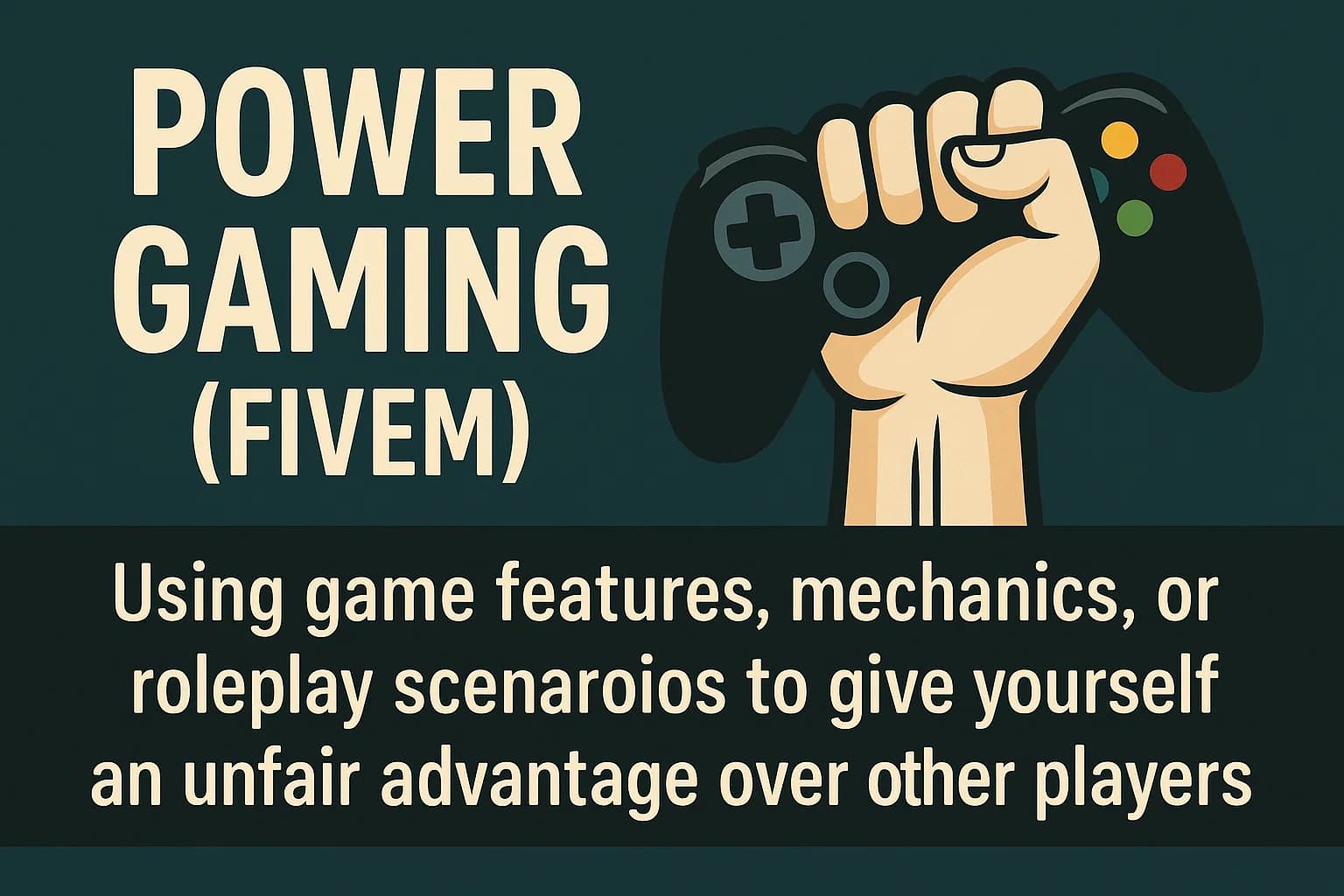
Power gaming is forcing unrealistic actions or outcomes on other players without allowing them to respond or react naturally in roleplay scenarios. At its core, it violates the fundamental contract of collaborative storytelling: every player should have agency over their character.
Roleplay works because participants agree to share control of the narrative. When one player dictates what happens to another player's character — deciding the outcome of a fight, declaring that their action succeeds without giving the other person a chance to respond, or claiming abilities that don't exist in the game — that agreement breaks down. The result is an experience that feels less like shared storytelling and more like one person playing a single-player game while everyone else watches.
Power gaming isn't always intentional. New players often don't realize they're doing it. But the impact is the same regardless of intent: other players feel powerless, immersion breaks, and the quality of roleplay drops for everyone involved.
Core Violations
Power gaming generally falls into three categories, each representing a different way of removing another player's ability to participate meaningfully.
1. Denying Player Agency
This is the most common form. Instead of presenting an action as an attempt, the player states it as a completed fact.
- "/me tackles you to the ground and you can't move" — forces an outcome
- "/me attempts to tackle you to the ground" — allows a response
- "/me grabs your phone and smashes it" — removes player choice
- "/me reaches for your phone" — opens interaction
2. Forcing Impossible Actions
Claiming abilities or outcomes that have no basis in the game's mechanics or realistic logic.
- "/me dodges all bullets Matrix-style" — physically impossible
- "/me dives behind cover" — realistic and allows counterplay
- "/me lifts the car with one hand" — absurd and immersion-breaking
- "/me hot-wires the car using tools from the trunk" — plausible action
3. Ignoring Game Mechanics
Refusing to acknowledge the game's systems when they produce unfavorable outcomes.
- Claiming immunity to game damage systems
- "My character has kevlar skin" — no in-game basis
- Refusing to go down after being shot multiple times
- Using actual in-game armor items — correct approach
Is This Power Gaming? A Decision Framework
Before you type a /me command, run it through these six checkpoints. If you hit a "yes" at any point, rewrite the action before sending it.
Checkpoint 1 — Does my action state a completed fact about someone else's character? Yes → Power gaming. Rewrite using "attempts to."
Checkpoint 2 — Does my action require the other player's character to fail, comply, or be incapacitated without giving them a choice? Yes → Power gaming. Give them a window to respond.
Checkpoint 3 — Does my action claim a physical ability that can't exist in the game world (inhuman strength, bullet immunity, instant teleportation)? Yes → Power gaming. Ground your action in realistic possibility.
Checkpoint 4 — Does my action ignore or override a game mechanic that went against me (damage, handcuffs, a lost fight)? Yes → Power gaming. Accept the mechanic's outcome and RP from there.
Checkpoint 5 — Does my action claim a resource — a weapon, a tool, a piece of evidence — that isn't in my character's inventory or wasn't established in the scene? Yes → Power gaming. Only use what you actually have.
Checkpoint 6 — Did I give the other player enough time to read and respond before following up?
No → Borderline power gaming. Slow down; rapid-fire /me chains that skip responses deny agency even when each individual line is phrased correctly.
If all six answers are "no," your action is clean. Print this list and pin it to your Discord's #rules channel — it's the fastest way to onboard new players before they commit a violation by accident.
10 Real-World Scenarios: OK, Borderline, or Power Gaming?
These scenarios cover the most common situations admins receive reports about. Each one is labeled and explained so you can calibrate your instincts before you're in the middle of a tense scene.
Scenario 1 — The Arrest
A police officer types: /me handcuffs the suspect and places them in the vehicle.
Power gaming. This skips the approach, the frisk, and the restraint entirely, writing the suspect's compliance into the action without their input. Correct version: /me approaches and reaches for the suspect's wrists, attempting to apply cuffs.
Scenario 2 — The Chase on Foot
A fleeing suspect types: /me sprints full speed and vaults the fence, leaving the officers far behind.
Borderline. The vault itself is realistic, but "leaving the officers far behind" decides what happens to other players' characters. Drop the second clause: /me sprints toward the fence and attempts to vault it.
Scenario 3 — The Drug Search
An officer types: /me searches the suspect and finds 50 grams of cocaine in the left jacket pocket.
Power gaming. The officer is inventing evidence that may not exist in the suspect's inventory and is also deciding what the search finds without any mechanic to back it up. The correct approach is to use the in-game search mechanic, or /me begins a careful search of the suspect's jacket.
Scenario 4 — The Bar Fight
Player A types: /me throws a punch aimed at Player B's jaw. Player B responds: /me steps back and tries to block with their forearm.
OK. Both players are using "attempts" language and leaving space for the scene to develop naturally. This is exactly how /me combat should work.
Scenario 5 — The Gunshot Wound
A player gets shot twice in a firefight and then types: /me dusts off and walks normally, unaffected by the shots.
Power gaming. Ignoring damage outcomes is one of the clearest violations in RP. Even if the player wants to continue the scene, their character needs to acknowledge and RP the injury.
Scenario 6 — The Lockpick
A criminal types: /me produces a lockpick kit and works on the lock for several minutes.
OK. The action is realistic, takes time, and doesn't force any outcome on another player. It sets up a fair window for a patrol to interrupt the scene.
Scenario 7 — The Interrogation
A detective types: /me slams the table. "You confess everything and start crying." directed at the suspect.
Power gaming. Writing another character's emotional state and dialogue into your own action is a direct agency violation. The detective can describe their own action: /me slams the table and leans forward. "Start talking." — then let the suspect decide how their character reacts.
Scenario 8 — The Medical Scene
An EMS responds to a crash and types: /me assesses the patient's injuries and begins stabilizing the broken leg.
OK. This is the EMS doing their job. They're describing their own actions, not forcing an outcome on the patient. The patient can still respond with how their character experiences the treatment.
Scenario 9 — The Hostage Situation
A criminal holds a hostage and types: /me presses the gun to the hostage's head. The hostage is completely calm and cooperative.
Borderline to power gaming. The gun press is fine. Dictating the hostage's emotional state and behavior crosses into forcing an outcome on another player's character. Remove the second sentence.
Scenario 10 — The Car Chase
A driver types: /me executes a perfect PIT maneuver and the target vehicle spins out and stops.
Power gaming. The outcome of the PIT is being decided by the driver, not the game mechanic or the other player. Correct: /me attempts a PIT maneuver, angling the cruiser toward the target's rear quarter. Whether it succeeds is determined by the game or agreed RP.
Power Gaming vs. Other RP Violations
Power gaming is often confused with other rule violations. Understanding the differences helps both players and admins handle reports correctly.
| Violation | Definition | Key Difference from Power Gaming |
|---|---|---|
| Power Gaming | Forcing actions/outcomes on others without allowing response | About removing player agency |
| Metagaming | Using out-of-character information in-character | About information, not actions |
| Fail RP | Breaking character or ignoring scenario logic entirely | About breaking immersion, not forcing outcomes |
| RDM (Random Deathmatch) | Killing players without any roleplay reason | About unprovoked violence |
| VDM (Vehicle Deathmatch) | Using vehicles as weapons without RP justification | Subset of RDM using vehicles |
A single incident can involve multiple violations. For example, a player who uses Discord to learn a rival gang's location (metagaming), drives there and runs people over without saying a word (VDM/RDM), then claims "/me is bulletproof" when shot at (power gaming) has committed three separate violations in one sequence.
How Admins Handle Power Gaming: The Enforcement Ladder
Most FiveM RP servers use a progressive discipline system. The exact thresholds vary by community, but the logic is consistent: give new players room to learn, escalate for pattern behavior, and protect the experience for everyone else.
Rung 1 — Verbal Warning
When it applies: First offense, clearly a new player, no malicious intent, minor impact on the scene.
What it looks like: An admin teleports to the player, pauses the scene, and explains in plain terms what the violation was and how to avoid it. Many servers do this via a private DM rather than in front of other players to avoid embarrassment.
Example: A new civilian types /me tackles the cop to the ground and ties their hands. An admin privately messages: "Hey, that /me forces an outcome on another player's character. Try '/me attempts to tackle the officer.' If they want to RP the result, they'll respond." No formal record is created; the conversation is logged informally by the admin.
Rung 2 — Written Warning (Formal Strike)
When it applies: Second offense, or first offense that significantly disrupted an active scene (broke up a police arrest RP, ended a medical scene prematurely, forced a major story outcome).
What it looks like: The warning is added to the player's admin record with a timestamp, description of the violation, and the admin who issued it. Players are told the warning exists. Most servers allow one or two written warnings before escalation.
Example: The same player, one week later, is involved in a hostage situation and types /me zip-ties both officers and drags them to the van. They can't resist. This is their second offense and directly overwrites the agency of two other players in an active scene. Admin issues a written warning and links them to the server rules.
Rung 3 — Temporary Kick or Session Timeout
When it applies: The violation is actively disrupting an ongoing scene and the player is unresponsive to admin intervention, or this is a repeat offense following written warnings.
What it looks like: The player is removed from the session for the current play session or a short defined period (30 minutes to a few hours). Their position in any active scene is written out by the admin team.
Example: A player during a major server event repeatedly ignores /me response windows, rapidly firing actions that force outcomes on a group of five players in a coordinated heist scene. After a verbal warning is ignored mid-scene, the admin kicks them for the session to protect the event for the other participants.
Rung 4 — Temporary Ban (1–7 Days)
When it applies: Third formal violation, or a single egregious offense — claiming permanent immunity to all damage across an extended session, systematically ruining RP for multiple players across multiple scenes.
What it looks like: The player receives a ban message explaining the duration, the violation, and how to appeal. Most servers require the player to submit an appeal explaining what they did wrong before the ban is reviewed. Appeals that demonstrate genuine understanding of the rule are treated more favorably than ones that contest the facts.
Example: A player with two existing written warnings is reported by three different players in the same session for separate power gaming incidents. Admin issues a 3-day temp ban with a required written appeal.
Rung 5 — Permanent Ban
When it applies: Pattern of violations across multiple ban cycles, a single incident severe enough to warrant immediate removal (deliberately destroying a planned server event, systematic harassment via power gaming), or falsifying appeals.
What it looks like: The player's identifiers are added to the permanent ban list. Most servers make permanent bans reviewable after a waiting period (often 90 days to 6 months) if the player can demonstrate understanding and change. Some violations — particularly those combined with harassment or racist behavior — carry no appeal window.
Example: A player has been temporarily banned twice and returned each time without meaningful improvement. In their third return, they spend an entire evening in police RP claiming immunity to every arrest mechanic and writing officers' responses into their own /me commands. Permanent ban issued with no immediate appeal window.
For a complete breakdown of how serious RP servers structure their discipline systems, see our guide to the best FiveM police scripts — many of the enforcement mechanics built into top police job scripts enforce these same rules automatically.
Community Rule Templates
One of the most practical things a server owner can do is paste clear power gaming rules directly into their Discord rules channel or server handbook. Vague rules get disputed. Specific rules with examples are harder to argue against and easier for players to internalize before they join.
Here are four paste-ready templates. Copy, adapt the server name placeholder, and drop them directly into your rules page.
Template 1 — Basic Power Gaming Rule (All Servers)
3.4 — No Power Gaming

You may not force actions, outcomes, or emotional states on another player's character without their consent. All /me actions must describe what your character attempts, not what happens to someone else.

WRONG: /me tackles the officer and pins them to the ground. They cannot move.
RIGHT: /me lunges at the officer, attempting to bring them to the ground.

Wait for the other player to respond before continuing the scene. Posting multiple /me commands without leaving response time is a violation of this rule even if each individual command uses "attempts" language.

First offense: Verbal warning. Repeated offenses escalate per our punishment system.
Template 2 — Extended Rule for Serious RP Servers
4.2 — Power Gaming and Forced Outcomes

Power gaming is any action that removes another player's ability to control their own character. This includes but is not limited to:

- Declaring another character's physical state, emotions, or dialogue in your own /me
- Claiming an outcome of a physical action without giving the other player a response window
- Ignoring damage, restraint, or other game mechanics that produced an unfavorable result
- Using equipment, weapons, or items not present in your in-game inventory
- Claiming supernatural or physically impossible abilities

All roleplay actions must remain within the bounds of physical possibility for a normal human character in a modern city setting, unless a specific character background has been pre-approved by staff.

Violations are logged. Three confirmed violations within a 30-day period result in a temporary ban.
Template 3 — Police-Specific Power Gaming Rule
5.1 — Law Enforcement Power Gaming

Officers may not:

- Write a suspect's compliance, resistance, or emotional state into their own /me commands
- Claim to find evidence that was not discovered through in-game mechanics or observed during the scene
- Perform instant arrests without any roleplay interaction (verbal commands, approach, frisk)
- Dictate the outcome of a use-of-force situation without allowing the suspect a response window

Officers may:
- Use authoritative language in their own dialogue
- Describe their own actions in detail using /me
- Escalate mechanically if a suspect ignores RP entirely (this falls under a separate FailRP rule)

Violations reported by three or more witnesses in a single incident will be reviewed by senior admin without a verbal warning stage.
Template 4 — New Player Onboarding Snippet (Short Version)
Welcome to [SERVER NAME]! Quick rule check before you join your first scene:

When you use /me, describe what your CHARACTER TRIES TO DO — not what happens to someone else.
  OK: /me tries to grab the bag
  NOT OK: /me grabs the bag and runs off before anyone can react

Always wait for other players to respond before following up.
If you're unsure whether something counts as power gaming, ask a staff member in #support before the scene, not after.
Feel free to adapt these templates to your server's voice and rule numbering. The key elements that make them work are: a clear statement of the rule, a concrete wrong/right example, and a stated consequence so players know the stakes up front.
How to Improve Your RP and Avoid Power Gaming
Good roleplay habits eliminate most power gaming naturally. These tips apply whether you're on a serious RP server or a more casual community.
Use "attempts to" language. This is the single most important habit. Instead of declaring what happens, describe what your character tries to do. Let the other player decide how their character responds.
Wait for responses. After posting a /me action, pause. Give the other player time to read, think, and respond. Rapid-fire /me commands that don't leave space for interaction are a form of power gaming even if each individual command uses "attempts" language.
Respect game limitations. If the game says you're down, you're down. If your inventory doesn't have a weapon, you don't have a weapon. Game mechanics exist as a shared framework that keeps roleplay grounded.
Accept losses. Not every scenario will go your way. Getting arrested, losing a fight, having your car stolen — these are all opportunities for interesting RP. Characters who never lose are boring to interact with and frustrating for everyone else.
Know your character's limits. A mechanic shouldn't perform surgery. A civilian shouldn't outshoot trained police officers. Building a character with realistic strengths and weaknesses creates better stories than playing an invincible superhero.
Ask OOC if unsure. If you're not sure whether an action would be considered power gaming, ask the other player in OOC chat. Most experienced roleplayers are happy to discuss boundaries before a scene rather than deal with a rule violation report afterward.
Looking for job scripts that enforce fair roleplay mechanically? The scripts in our essential FiveM job scripts guide include police, EMS, and criminal frameworks with built-in procedure enforcement that makes power gaming in job-specific scenarios much harder to pull off.
Detection Methods
Servers use a combination of automated and manual approaches to catch power gaming:
- Action logs — Server-side monitoring of /me commands, flagging patterns like rapid-fire actions or keywords associated with power gaming
- Player reports — In-game reporting systems that capture context (timestamps, nearby players, recent chat history)
- Admin spectating — Direct observation of suspicious players, often triggered by reports
- Automated flags — Scripts that detect suspicious patterns such as impossible action sequences or ignored damage events
Technical Enforcement
Some servers implement automated detection to catch obvious power gaming patterns before they require admin intervention:
RegisterCommand('me', function(source, args)
    local text = table.concat(args, ' ')
    -- Flag absolute/forcing language
    if string.match(text, 'forces') or string.match(text, 'cannot') or
       string.match(text, 'impossible') or string.match(text, 'immune') then
        TriggerClientEvent('chat:addMessage', source, {
            args = {'SYSTEM', 'Potential powergaming detected. Use "attempts" language instead.'}
        })
        -- Log for admin review
        TriggerEvent('admin:logPowergaming', source, text)
        return
    end
    -- Process normal /me command
    TriggerClientEvent('chat:addMessage', -1, {
        args = {GetPlayerName(source) .. ' (me)', text}
    })
end)
More sophisticated systems track action frequency, cross-reference with game state (did the player actually have the item they claim to use?), and flag impossible sequences like performing actions while handcuffed. These automated tools don't replace human judgment — they surface potential issues for admins to review.
Servers looking to build robust job systems often integrate power gaming detection into job-specific mechanics. For example, a police job script can enforce proper arrest procedures by requiring each step to complete before the next one begins, making instant-cuffing technically impossible rather than just against the rules.
Prevention Guidelines
For Players:
- Use "attempts to" instead of absolute statements
- Wait for responses before continuing actions
- Respect game limitations and your character's abilities
- Accept unfavorable outcomes gracefully
- Learn from warnings rather than arguing them
For Server Admins:
- Write clear, specific rule documentation with concrete examples (use the templates above as a starting point)
- Enforce rules consistently across all players, including staff
- Provide example scenarios in your rules page — show both the wrong and right way
- Create a mentorship system where experienced roleplayers help newcomers
- Use progressive discipline rather than jumping straight to bans
- Build enforcement into your scripts where possible — mechanical friction beats manual intervention
For broader server health advice, including how rule quality affects player retention, see our complete FiveM server guide and the 10 mistakes to avoid as a server owner breakdown.
Summary: Power gaming in FiveM means forcing actions or outcomes on other players without allowing proper roleplay responses, violating the fundamental principle of collaborative storytelling. The fix is simple in concept — use "attempts" language, wait for responses, and accept that good RP means sometimes losing. For admins, the fix is equally straightforward: clear rules, consistent enforcement, and scripts that make violations mechanically harder to pull off in the first place.